
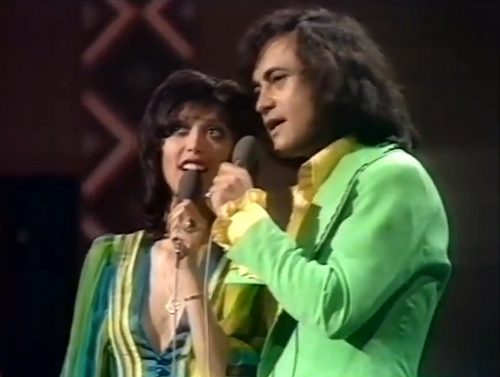
Today we received the sad news that Dries Holten passed away on April 15. Dries is better known as Andres, who achieved great fame as half of the duo Sandra & Andres. The duo got together in 1966 and sang together until 1975. After that Andres continued as half of the duo Rosy & Andres, and in the early eighties with Debbie & Andres. In 1969 Andres also had a solo hit in the Netherlands, “Zij is verliefd op een frikandel”.
In 1972 Sandra & Andres participated in the Eurovision Song Contest for the Netherlands and reached fourth place. Four years later, Rosy & Andres also took part in the national final with the song “I was born to love”. The duo did not win.


Eurovision 2026
Weekly Update 1
🇧🇬 DARA returns home to a hero’s welcome in Bulgaria Bulgaria celebrated its first ever Eurovision victory in style this week. On Sunday, a red carpet, a “Bangaranga” flash mob at Sofia’s Vasil Levski Airport, and hundreds of fans waving posters and Bulgarian flags, some dressed in traditional kukeri costumes, greeted DARA upon her arrival from Vienna. Culture Minister Evtim Miloshev and Sofia Mayor Vasil Terziev were among the officials who welcomed her. That was before she disappeared into the sea of supporters gathered at the terminal. DARA addressed the crowd with an emotional speech. She thanked her fans and called on Bulgaria to support its many talented artists. Her music producer Sania Armutlieva told BNT: “There’s no slowing down now. This is her moment.” DARA secured victory in Vienna on May 16 with the largest winning margin in Eurovision’s 70-year history, receiving 516 points in total, including 312 from viewers. source: brnnews 🇧🇬 Kirkorov claims involvement in “Bangaranga” — co-writer and team deny it The post-contest buzz has not been without controversy. Videos circulated online after the final showing Russian singer Philipp Kirkorov discussing Bulgaria’s Eurovision performance and claiming that his team had participated in preparing DARA’s stage production. Kirkorov is a long-standing public supporter of Russian President Vladimir Putin. According to Eurovision’s official credits, Greek composer Dimitris Kontopoulos was among the writers of “Bangaranga.” Kontopoulos has an established history of collaboration with Kirkorov, having worked together on several Russian Eurovision entries in the 2010s. source: united24media Philipp Kirkorov However, both denied Kirkorov’s involvement in this specific project. Kontopoulos told RFI on May 18 that while Kirkorov has supported him over the years, he was not involved in this particular project. Co-producer Kristian Tarcea also denied any Kirkorov involvement, stating the track was created by four contributors: himself, DARA, Kontopoulos, and a composer named Anna. Ukrainian stage designer Nicholas Chobb, who worked on the performance, said he first learned of Kirkorov’s claims on social media and could not confirm his participation at any stage of the production process. Neither DARA nor Bulgaria’s public broadcaster BNT publicly commented on Kirkorov’s statements. source: united24media 🇧🇬 Four Bulgarian cities want to host Eurovision 2027 The race for the Eurovision 2027 host city has already begun. Bulgarian Culture Minister Evtim Miloshev confirmed that the Council of Ministers will create an organisational structure for the country’s hosting of the Eurovision Song Contest. Sofia, Bulgaria Sofia, Plovdiv, Varna and Burgas have all expressed interest in staging the event. The minister indicated that Sofia’s infrastructure gives it an advantage, but called the interest shown by three other major cities a positive sign. He said the most reasonable approach is to consider all options before making a final decision. No timeline for that decision has been announced yet. source: bnrnews 🇱🇺 🇲🇨 In memoriam: Romuald (1938–2026) The Eurovision community lost a unique figure this week. Romuald Figuier, known simply as Romuald, passed away on 14 May 2026. He was 87 years old. Born on 9 May 1938 in Saint-Pol-de-Léon, Finistère, Romuald was a French singer and composer who represented three different countries at Eurovision. He remains the only French-speaking artist to have achieved that distinction. Romuald represented Monaco in 1964 with “Où sont-elles passées?”, finishing third, then Luxembourg in 1969 with “Catherine”, and Monaco again in 1974 with “Celui qui reste et celui qui s’en va”, finishing fourth. He began his career at the Théâtre des Variétés and later provided the French voice of George Chakiris in “Les Demoiselles de Rochefort” in 1967. Throughout his career he composed numerous songs, many in collaboration with lyricist Magali Fallourd. You can read his full biography in our encyclopedia. source: Le Figaro That’s it for this week’s Eurovision Universe weekly update. Stay tuned for more Eurovision 2026 and Eurovision 2027 news as it develops.
